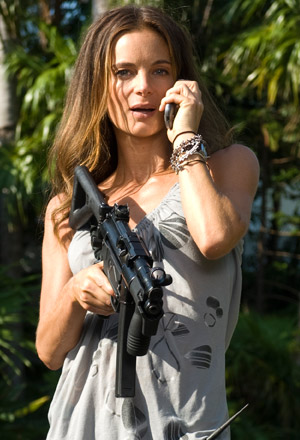
Because this show is filmed in Miami, sexuality, race, and gender are frequently exploited. For example, the environment of Miami consists of women walking the streets in bikinis and skimpy clothing. Thus women, nudity, and beauty are almost synonymous in this television show. Sexuality is promoted with the beautiful women of Miami, but specifically emphasized with Fiona. She uses her sex appeal to manipulate the enemy, which usually consists of men, and thus her characterization promotes the stereotype of the femme fatale. Furthermore, her stereotype promotes the idea that men are blinded by sex. Another way sex is exploited in this show is through Sam’s character. Sam, a flirt, sleeps with multiple older women in exchange for food and shelter. He promotes sex as a bartering tool and a form of manipulation.
Many cut scenes show girls in bikinis, classy homes, and beautiful birds eye view shots of Miami.
While this show promotes many stereotypes, the gender roles of the main characters are swapped. Fiona, while a femme fatale, contradicts this traditional stereotype. She’s portrayed as an equal to Michael physically and intellectually. Her experience with guns and explosives makes her an independent and powerful woman, something that is rarely seen in hard-boiled mystery and film noir.
Race and class hierarchies are explored through the criminal characters. Many times, Michael and his crew deal with criminals and fellow spies of a different ethnicity, usually Hispanic or African American. This coincides with the stereotype that Hispanics and African Americans are highly involved in criminal activity. Also, many of the higher listed criminals Michael deals with are wealthy. This is because, in Miami, money defines how successful and powerful you are. This includes drug traffickers, mobsters, and con-artists. Thus, in this show, race and class segregate the criminals from the rest of society.
skip to main |
skip to sidebar

Search This Blog

Burn Notice Information
Burn Notice is about to start its 4th season on Thursday, June 3rd. Its shows on Thursdays on 9 on the USA network. For more information visit:
Bibliography
Banner:
http://media.photobucket.com/image/burn%20notice%20banner/mamasagbe/BurnNotice-Banner.jpg
Summary Image:
http://2.bp.blogspot.com/_OvryYdVtfSo/Siiv_16kItI/AAAAAAAAESE/NqLXa2w4Xg/s400/Burn_Notice_Season_3_June_Michael_Fiona_sunglasses_billboard_poster_ad.bmp
Setting and Violence Image:
Setting Video:
http://www.youtube.com/watch?v=k790Ymo-KiA
Characters Images:
http://www.foxylicious.co.nz/content/binary/WindowsLiveWriter/FashionMuseMichaelWesten_DA50/0000049802_20080709115542_thumb.jpg http://www.fastdates.com/FastDatesNews2008/GabrielleSniper06.jpg http://www.collider.com/uploads/imageGallery/Burn_Notice/burn_notice_bruce_campbell_sam_axe_04.jpg http://www.burnnotice.info/wp-content/gallery/madeline-westen/sha_char_01.jpg
http://media.photobucket.com/image/burn%20notice%20banner/mamasagbe/BurnNotice-Banner.jpg

Summary Image:
http://2.bp.blogspot.com/_OvryYdVtfSo/Siiv_16kItI/AAAAAAAAESE/NqLXa2w4Xg/s400/Burn_Notice_Season_3_June_Michael_Fiona_sunglasses_billboard_poster_ad.bmp

Plot Formula Image:

Setting and Violence Image:

Setting Video:
http://www.youtube.com/watch?v=k790Ymo-KiA
Characters Images:
http://www.foxylicious.co.nz/content/binary/WindowsLiveWriter/FashionMuseMichaelWesten_DA50/0000049802_20080709115542_thumb.jpg http://www.fastdates.com/FastDatesNews2008/GabrielleSniper06.jpg http://www.collider.com/uploads/imageGallery/Burn_Notice/burn_notice_bruce_campbell_sam_axe_04.jpg http://www.burnnotice.info/wp-content/gallery/madeline-westen/sha_char_01.jpg



Group Members
- Sam Eichenblatt, Elaine Zhu, and J.C. Lanier
- This blog was created for Professor Crandall's 1102 English course at the Georgia Institute of Technology. It provides an in-depth analysis of the television series "Burn Notice."